
Brushes
If this process is not working for you, please try the following:
- If you have a 3rd party unzipping app on your iPad (iZip etc) please delete this app and don’t use it to try to open the files, as these apps are no longer supported by Apple and can cause problems opening files.
- If you have attempted to open the file before the download finished, this would stop the download so that it wouldn’t continue downloading. Please delete the partially downloaded file and then try the download again.
- Sometimes there is an issue with the internet connection during download that can stop a download in progress. This should also be solved by deleting the file and trying again.
- If the problem persists, please also try using a different browser or device to see if this solves the problem.
- Sometimes there can be strange little bugs stuck in the system which can be resolved by re-starting your iPad, so please try this if you have not already.
- Please check to make sure you still have plenty of available space on your iPad. You can do this by going to the settings app -> general -> iPad storage, where it will tell you how much space you have left.
With .swatches and .brushset files, they should just open in Procreate when you tap them from the Files app. However in case this doesn't work for any reason, here are the steps to send them to Procreate using the share button.
- Open the folder so that you can see the individual files that end in .brushset and .swatches.
- Tap "select" in the top right corner
- Tap the file(s) that you want to move to Procreate so that a blue check mark shows on top of the file icon.
- Tap "share" in the bottom left corner
- In the menu that pops up, you should see a row of your contacts, then under that a row of apps that you could send the file to. Procreate might appear on this list and if it does tap it, but if it doesn't, scroll all the way to the right and tap "more"
- Under "suggestions" Procreate should appear, tap it there.
- Once you tap the procreate app in this process, the files should be sent there. If it's a brush set it will appear at the top of your brushes list, and if it is a swatches file, it should appear at the bottom of your swatches list.
METHOD 1
When the files have finished downloading, they should be located in your iCloud Drive -> Downloads folder which you can access by using the Files utility app that comes with the iPad.
You can use the app to tap the .Zip file and it should create a new blue unzipped folder which you can go into and tap the Procreate files to load them in Procreate.
Here is a video showing how to do that process: https://youtu.be/0z2k12UD0ac
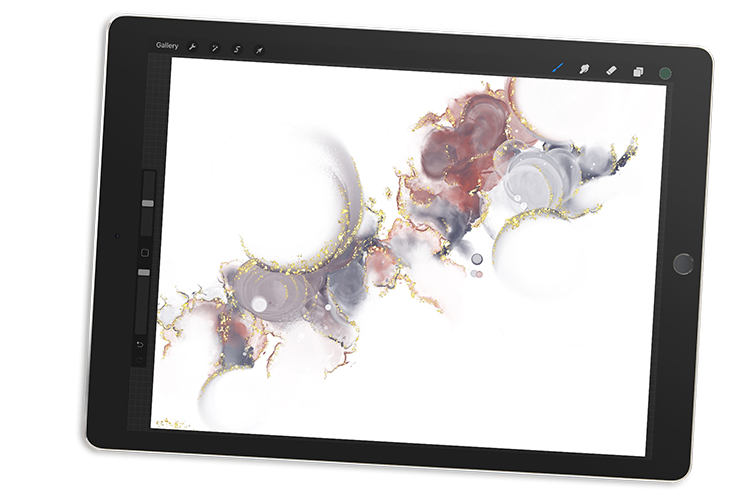
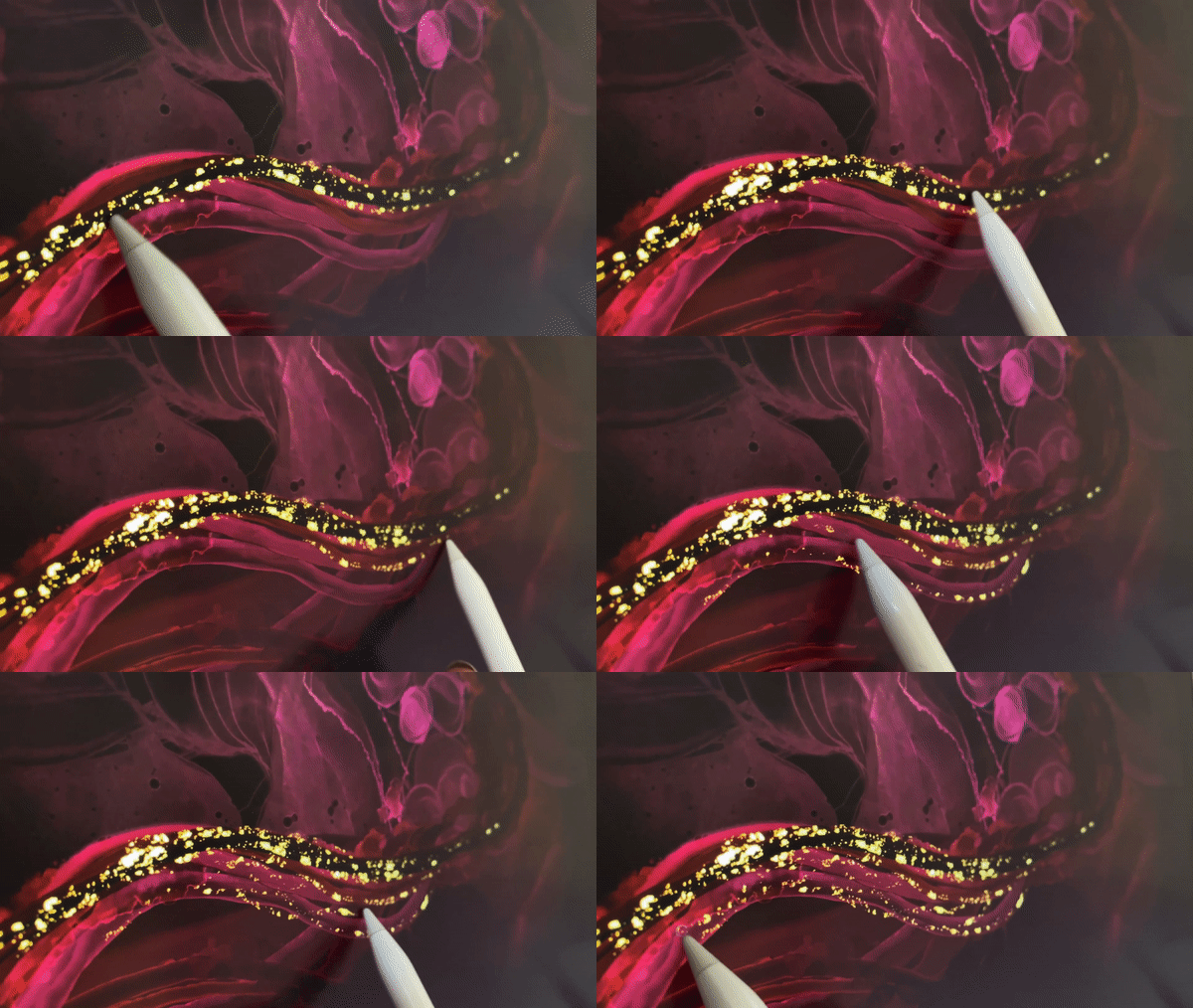
The first thing to be aware of with metallic brushes is that they need to be on a separate layer, above the rest of the artwork. If you are using them on the same layer as something else, they often come out looking flat white because they interact with what is already on that layer, which is why they need their own layer.
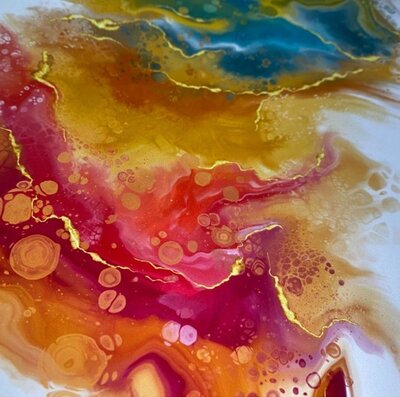
It can also be difficult to choose colors that work well with metallic brushes, which is why in some brush sets I’ve included color palettes specifically for this. Generally, darker colors work best and have more depth.
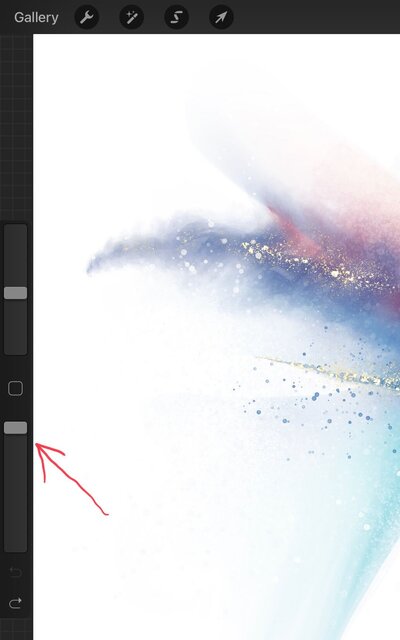
Your artwork might look faded if the opacity is turned down.
You can fix that by making sure the bottom left slider is turned all the way up:
I do print the artwork with metallics and it generally prints quite well, but the main thing to keep in mind is that it’s not true metallics when printed, meaning that it won’t reflect light the way real metallics would. It prints out more like a picture of something sparkly, so that it can give the impression of metallics but on closer inspection it’s just a photo, I hope that makes sense?
If you are in our facebook group (groups/AlainaJensenBrushes), you can search for #printedartwork to see some examples of how other people’s prints have turned out.
I think that a print shop is probably a safer bet unless you have a really good quality printer. I also usually suggest going with glossy paper for the metallics and the alcohol ink, which is similar to the substrate that you would use for alcohol inks in real life anyway, and the glossy paper can enhance the shiny look of the metallics.
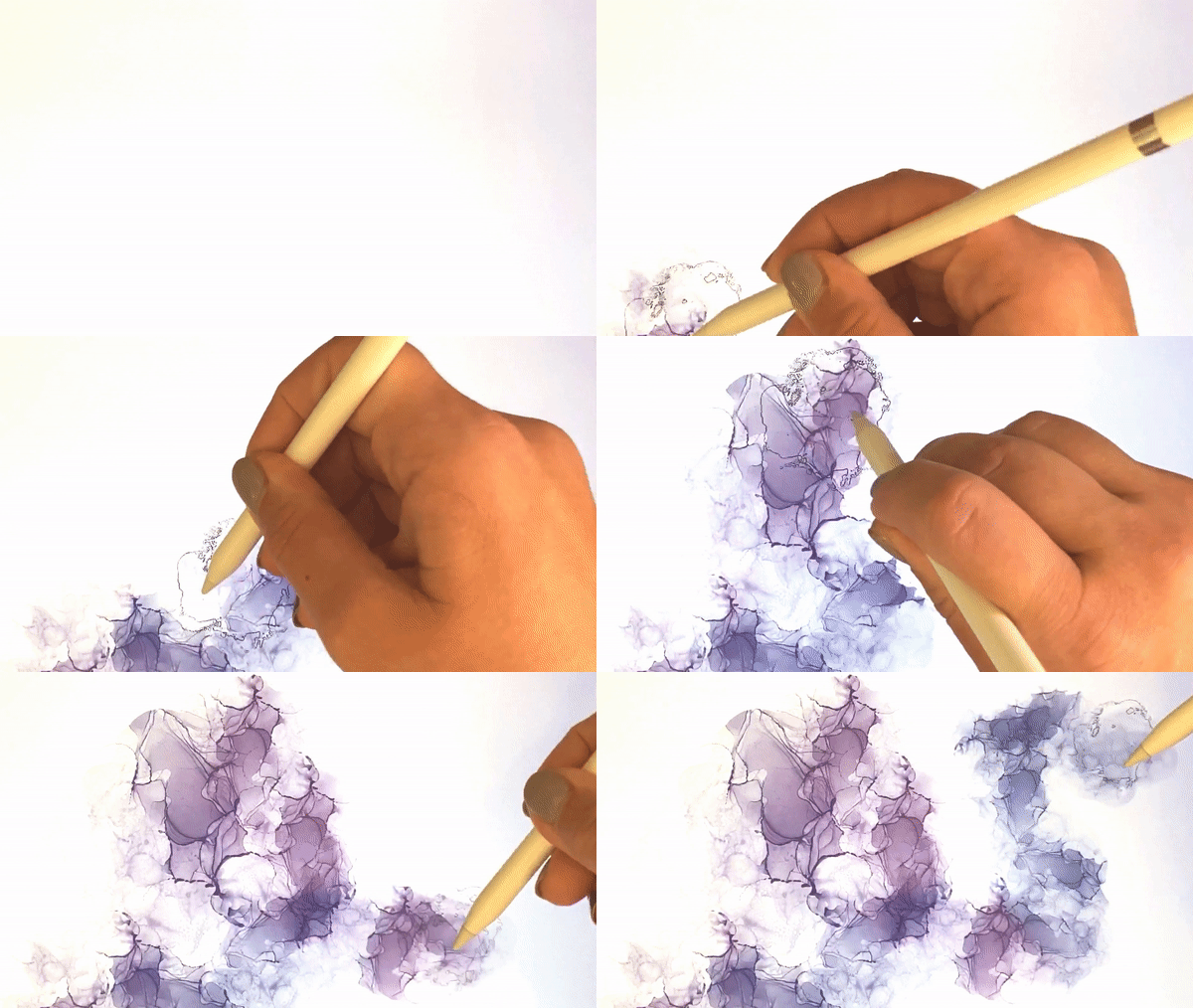
Several of my brush sets include blending brushes, which means they do not add anything new to the canvas, instead they blend what is already on the canvas in the particular layer you are on. So if you try using the brushes on a blank layer, nothing will happen because they are only meant to blend what is already there. Each of the blender brushes has a different style of blending so that you can smear and smudge what you have painted and pull it outward or fade it inward.
It’s not possible to make Vector/AI artwork in Procreate. It’s possible to use the “image trace” function in Adobe Illustrator or a similar program, however even with a very detailed photographic trace (that would create a huge file) this will likely result in artwork that is much less realistic looking (even “cartoony”) because that is the nature of vectors. It depends on the artwork in question, if it’s fairly simple artwork then you could give that a try but if it’s a very detailed piece with lots of texture and/or metallics, I would not advise it.
An iPad and either a 1st or 2nd generation Apple Pencil, or an Apple Pencil Pro, are essential for use with most of my brushes - this way you can use pressure to make the stroke bigger/smaller/more or less solid etc. This does not apply to stamp brushes.
If budget is a concern, you will be absolutely fine with a cheaper iPad. The main advantage of an iPad with more memory (like iPad Pro) is that it will enable you to have more layers and larger canvases, and also might have faster performance. However, most iPads will give you good enough performance for casual/hobby use as long as they are compatible with the right Apple Pencil.
There are multiple different versions of Apple Pencil - and different iPads have different compatibility with them. So it’s important to make sure that the pencil and the iPad that you buy are compatible with each other. It's very important to note that the Apple Pencil USB-C is NOT pressure sensitive and will not give you the functionality you need for digital art.
The following website gives you a list of which iPads are compatible with which pencil version, and as long as you buy an iPad and pencil combo that is listed on that page and does not include the USB-C version, you should be good to go with Procreate!
https://support.apple.com/en-gb/HT211029
The iPad app you will need is called Procreate, and the latest version which is what you can find in the app store. They are continually updating and improving the app, and I’m always testing my brushes when a new version of Procreate comes out to ensure that they are forward compatible.
I tend to use a large canvas because when exporting an image for print, it’s better to scale down than to scale up. So if I start with a 16x20" canvas and then decide I want to print it at 8x10” there is no loss in quality. But if it was the other way around and I started out with 8x10”, printing it any bigger than that would result in a pixelated image. It’s also important to make sure that your DPI is set to 300.
Purchases
- Try the purchase in a different browser, or update your browser and try again
- Try the purchase on a different device
- Turn off browser extensions and VPNs and try again
- Check to make sure you have enough funds in your account to cover the payment
- Call your card provider or contact PayPal and ask them if there are blocks or limitations on your account
If you purchased here on my website via Payhip (my payment partner), or on one of my other shops including Gumroad, Etsy, or Creative Market, you should have gotten an email receipt with a download button, sent to the email address you provided during the checkout process. If you do not see this email in your inbox, it may have gone into your spam/junk folder, which can happen sometimes depending on your email provider.
There are also instruction sheets with links to more videos, etc within the download folders, specific to that brush set.
If you have any trouble finding your download, you are very welcome to contact me and I will be happy to assist.
Any products that you have purchased while logged into your account should also appear in your dashboard after you have logged in.
If you made purchases before creating a login, you may need to migrate them to your account before you will see them on your dashboard, which is completely optional for your convenience.
You can do this by going to any previous purchase receipt email, and clicking the download button. Follow the "get started" button at the bottom of that page and you will be guided through the process. If you need me to re-send your receipts just let me know.
License
Yes you can use the brushes to create backgrounds for stock sites etc. The only precaution would be if you are using any stamp brushes (the kind where you tap the screen and a shape appears) they would need to be combined with other brushes, stamps or elements in order to be sold this way. If you are looking at any of my dynamic brushes like Amazing Alcohol Ink or Painterly, this is not a concern because these are not stamps.
You can read more about my license terms here: https://alainajensen.com/license
You are absolutely welcome and encouraged to sell the artwork that you make using my brushes! In fact, it makes me really happy to see other creatives succeeding in their entrepreneurial pursuits, which is why I sell my brushes with a built in commercial license.
You can read more about my license terms here: https://alainajensen.com/license
My understanding of NFTs is still very basic and I plan to continue researching and possibly revising my stance on this.
However from what I understand, an NFT has to be unique and copyrighted to the owner - while your artwork made with the brushes is absolutely your own work, there are elements in some of the brushes (shapes and patterns) which might be recognisable from one persons artwork to another as having been made with my brushes. So at this time I am not comfortable saying that my brushes can be used to make an NFT.